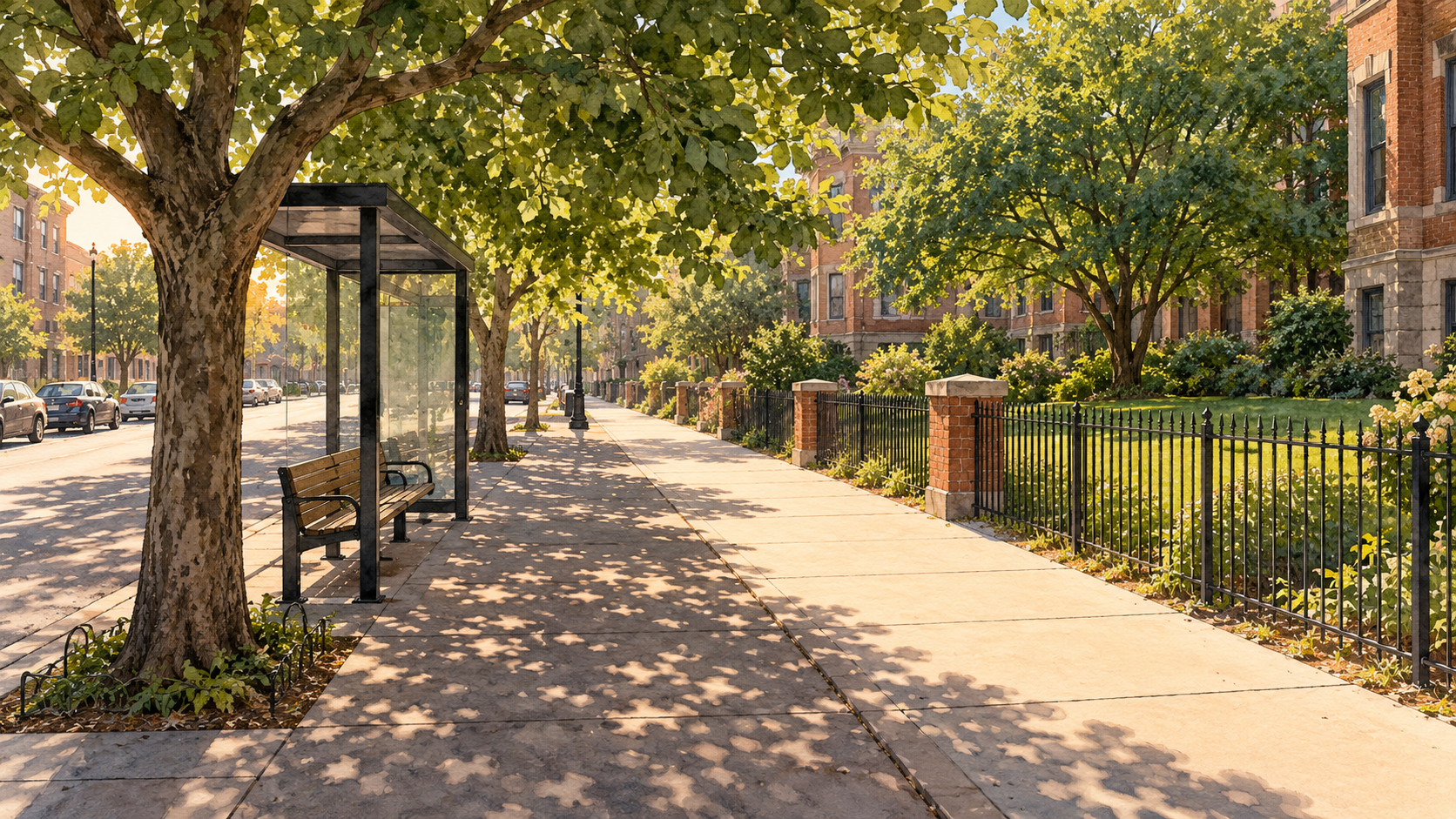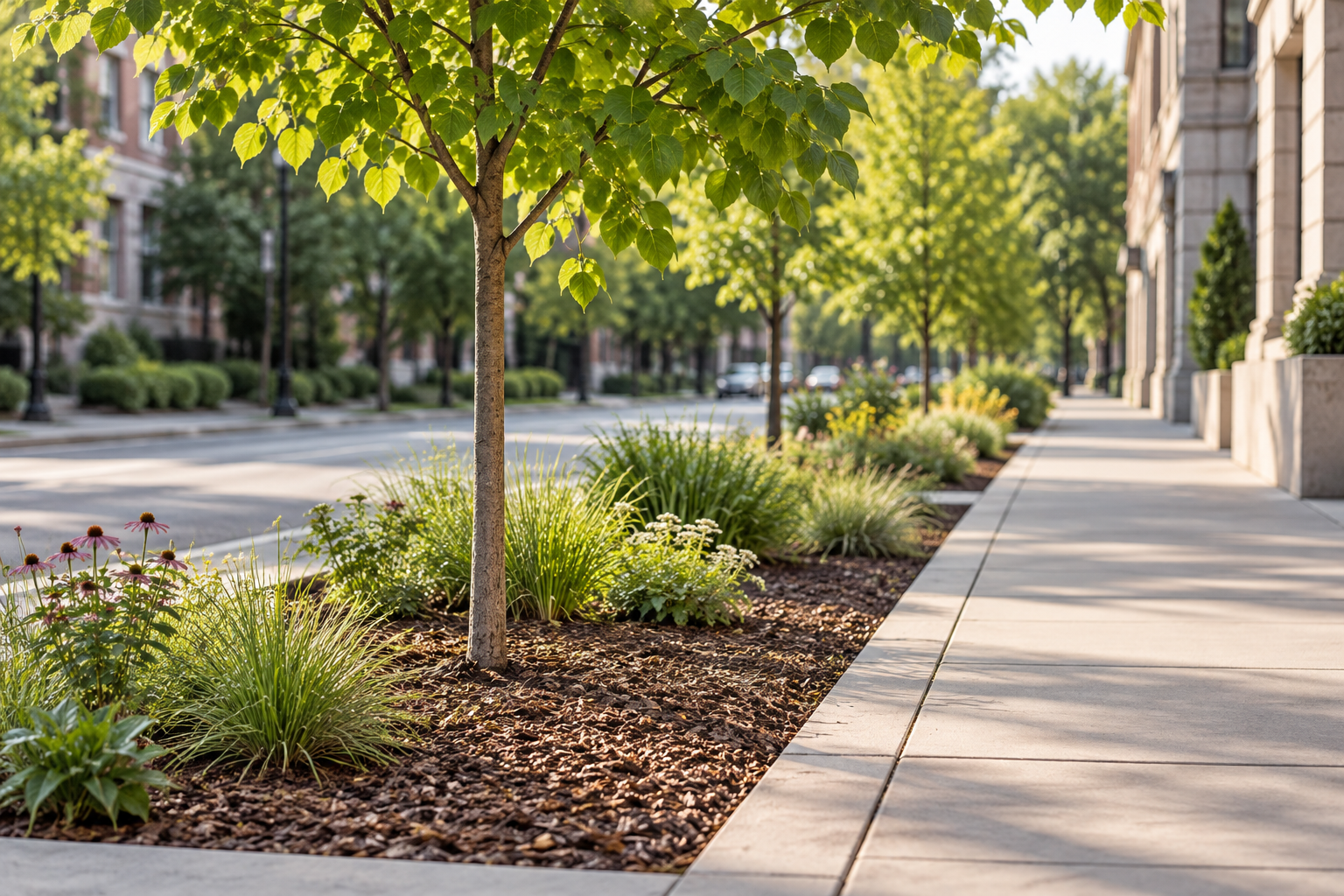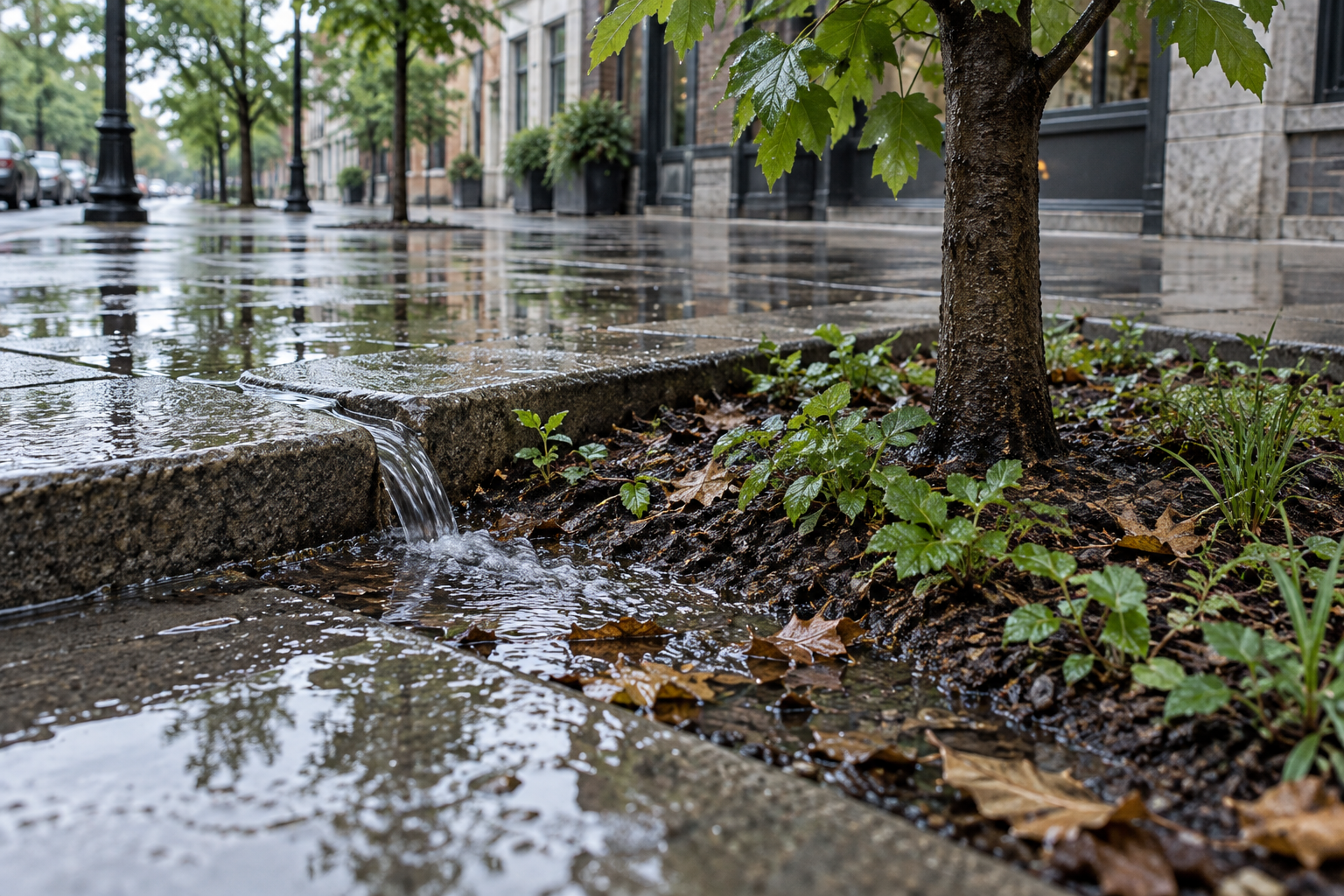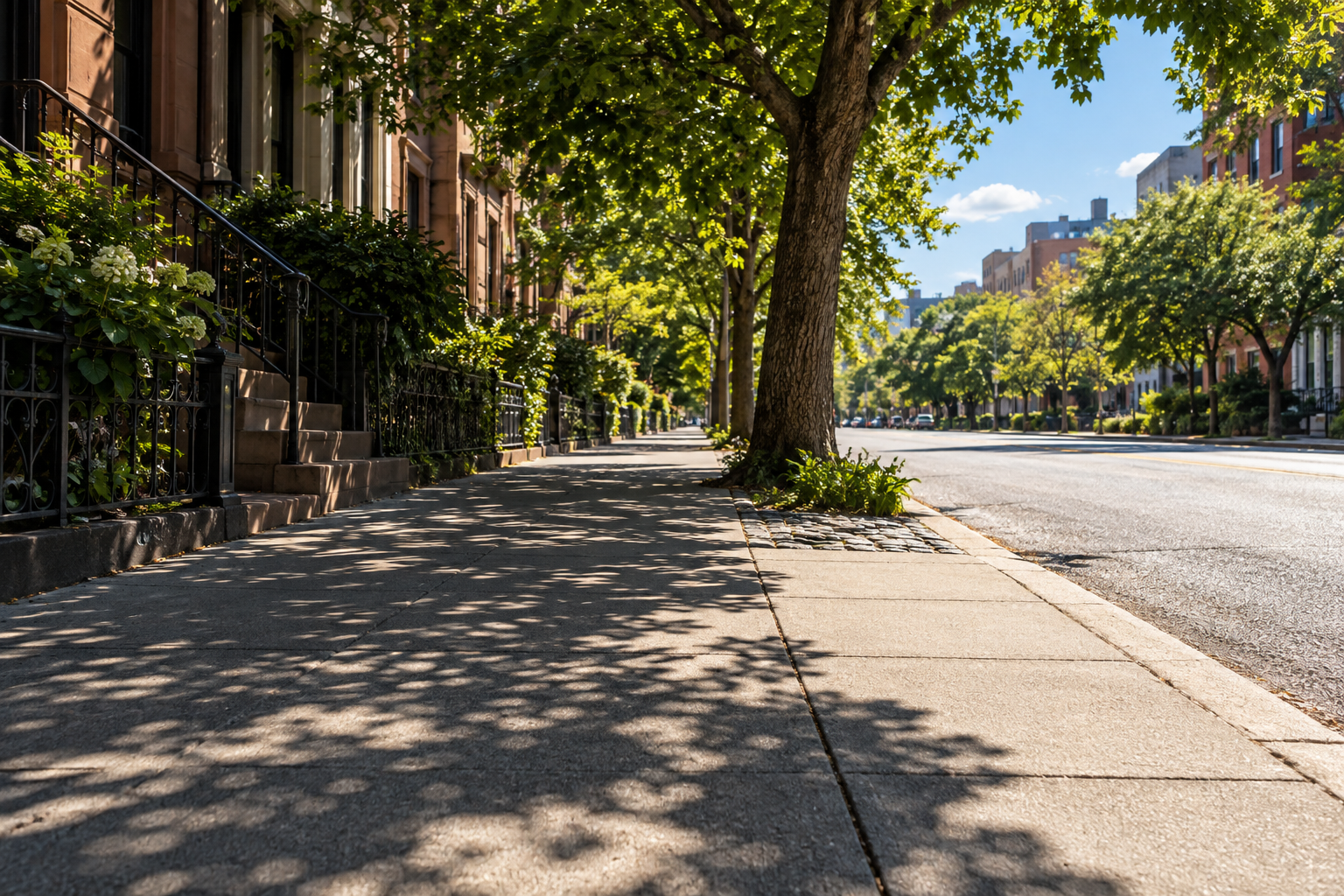
On a sunny sidewalk, a tree can change the walk before it changes the air. Step from the bright paving into the canopy's shadow and the sun no longer strikes your face or clothes directly. The asphalt beside you may still be warm; the air moving across the street may be much the same air. A thermometer that samples only air temperature can therefore miss much of what the pedestrian has gained.
Researchers who measured 51 small street trees in Manchester saw that distinction clearly. During their sunny summer sampling, air temperature in tree shade was not significantly different from air temperature nearby in the sun. Yet mean radiant temperature, a measure of the radiation reaching a person from the surroundings, was about four degrees Celsius lower in shade, and the shaded paving was about twelve degrees cooler. Those are measurements from particular streets and weather, not a fixed cooling value for every tree. They show that a local refuge need not announce itself on the air-temperature readout. Manchester street-tree study
Two temperatures, different questions
An ordinary air thermometer tells us about the air around its sensor. To study a person's outdoor heat exposure, researchers also consider sunlight and the infrared radiation emitted by warm surfaces. Mean radiant temperature combines those radiative exchanges into an equivalent temperature. It is not the temperature of the air, pavement or body, and it is not a direct promise of how comfortable any one person will feel. Wind and humidity matter too. The distinction is useful because an awning, building or canopy can interrupt a beam of sun almost immediately, while a patch of outdoor air mixes with the air beside it. Harbin field study and methods · Manchester study
In Harbin, China, a seven-day clear-sky field study compared a sunlit campus site with a site shaded by elm trees and another shaded by buildings. At the tree site, the researchers reported a mean reduction of 28.1°C in mean radiant temperature relative to the sunlit site, versus 1.9°C in air temperature. Building shade showed a similar large radiant reduction in that comparison. The investigators measured radiation from several directions, which matters because a standing person receives it from the sky, ground and surrounding walls, not only from directly overhead. The size of the Harbin difference is specific to those sites, surfaces and days. It should not be averaged with Manchester's four-degree result as though the experiments had sampled one identical street. Harbin original field study
The strongest immediate effect is often the loss of direct shortwave solar radiation. Shade also changes what the ground does later. An unshaded pavement absorbs sunlight and can become a source of longwave infrared radiation toward a walker. The Manchester team measured a much larger shade difference at the paving surface than in the air above it. In a separate Sydney study of 471 trees and five common ground materials, the shaded-to-sunlit surface difference depended strongly on the material: bitumen and bark mulch, for example, did not respond by the same amount as concrete pavers. That study found no systematic relationship between tree species and the surface-temperature difference within each material. It does not mean canopy form never matters; it means the thing being shaded belongs in the calculation too. Manchester study · Sydney surface study
Shade has a shape and an hour
A tree is not an umbrella with a constant footprint. Its crown has gaps, its shadow moves with the sun, and nearby buildings can block or reflect radiation. In the Manchester sample, denser leaf area was associated with more cooling of the ground surface, although the five species did not produce a simple ranking for every heat measure. A field study in a shallow street canyon in humid Wuhan found that streets with high canopy cover had larger afternoon reductions in both air and mean radiant temperatures than a comparable unshaded street; its reported maximum differences were 3.3°C and 13.9°C respectively. The Manchester and Wuhan results describe different climates and street forms. Their shared lesson is to measure the shade where a person actually stands, at the time the route is used. Manchester study · Wuhan field study
Nor does more overhead cover improve every part of an outdoor setting. A 2024 Taipei sidewalk study measured air at several heights. Most of the shaded versus unshaded air-temperature difference appeared close to the ground, between zero and half a meter; at heights from half a meter to two meters, the air temperatures differed little. The researchers also found that some higher shade arrangements impeded ventilation and could contribute to local overheating. It would be a mistake to turn that result into a case against trees. It is a reason to consider airflow along with solar protection, especially in a confined street. Taipei sidewalk study
The physical distinction matters to people, though comfort cannot be read from radiation alone. In Montevideo, Uruguay, researchers paired measurements with interviews on three downtown streets over four summer dates. Globe thermometers, which respond to radiant conditions as well as the air around them, recorded differences of up to eight or nine degrees between shaded and unshaded sections on those days. Of 120 people interviewed, the proportion describing themselves as comfortable was more than twice as high under tree shade as in unshaded sections. Many respondents in both settings still did not feel fully comfortable in summer heat. The result is a local survey, with a limited number of streets, dates and participants; it is evidence of perceived relief, not a measured reduction in heat illness. Montevideo field study
For a city deciding where to add cover, the unit of interest is often a route rather than a single air-temperature point. A shaded bus stop at noon may help someone waiting; a line of shade along a necessary walk may matter more to someone who cannot avoid the sun. A map of average neighborhood air temperature will not show which side of a street has afternoon protection or whether the pavement is radiating heat back upward. The field studies suggest measuring air, radiation, surfaces and wind at pedestrian height and at the hours people use a place, then asking residents what the route feels like. This is an inference about assessment, not a prescription that one tree shape or one temperature target suits all streets. Harbin field methods · Montevideo interviews · Taipei measurements
The air thermometer remains useful. It answers its own question well when properly shielded and placed. Under a tree, however, a pedestrian receives a changing mixture of sunlight, reflected light, heat from the ground and moving air. A small change in one reading can sit beside a large change in that exposure. To understand the relief of a shadow, measure the shadow's whole setting.
A thought worth keeping?