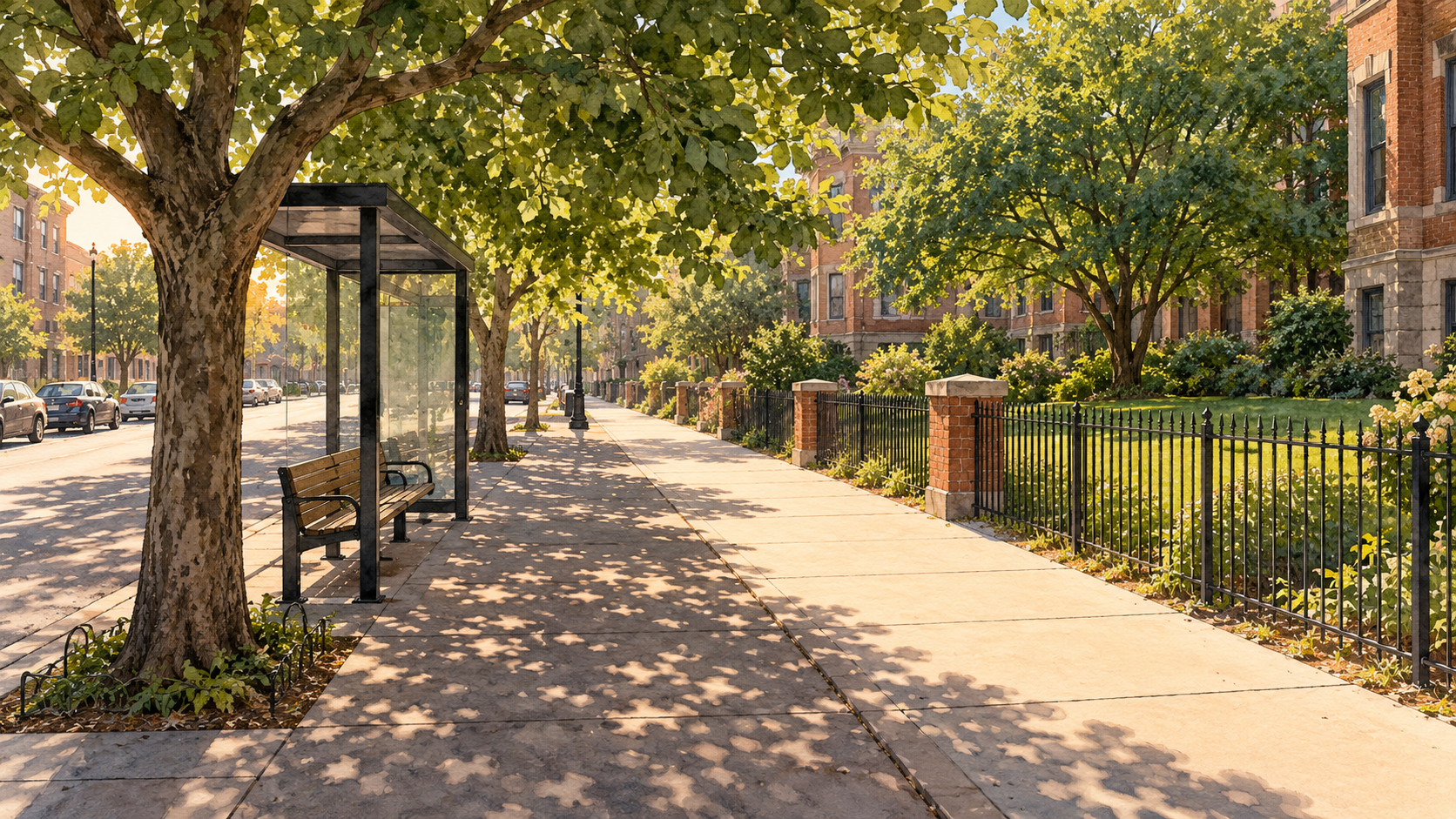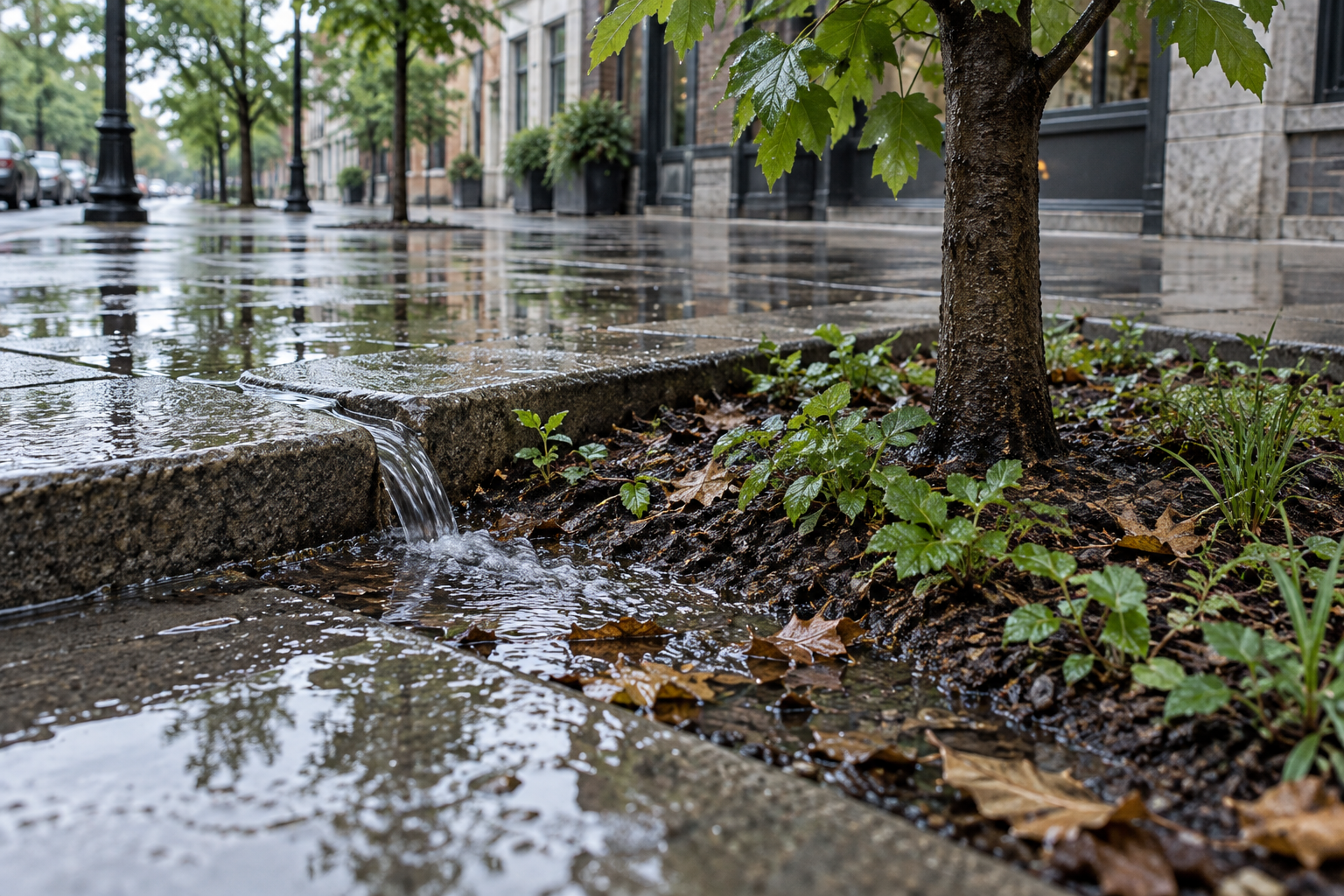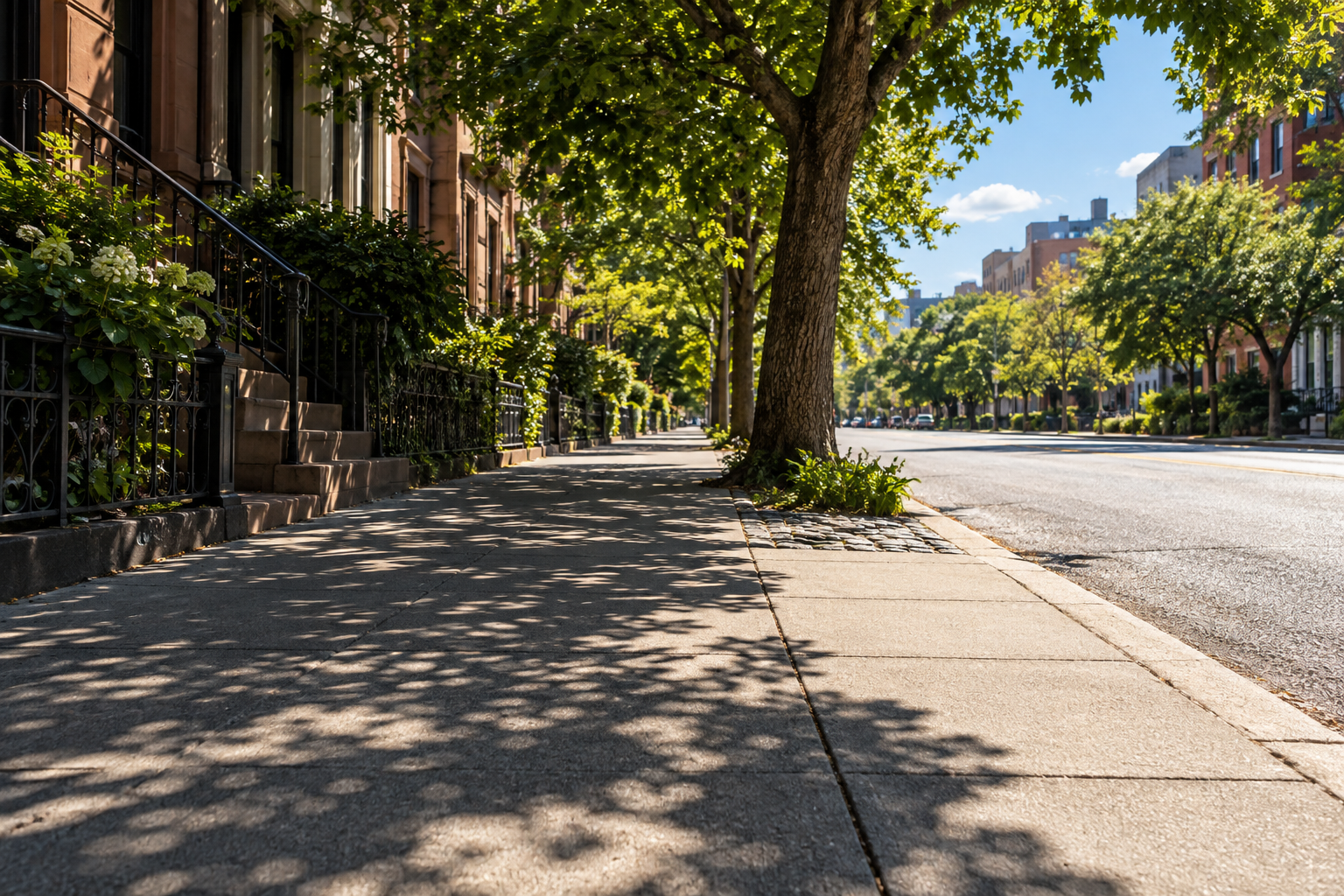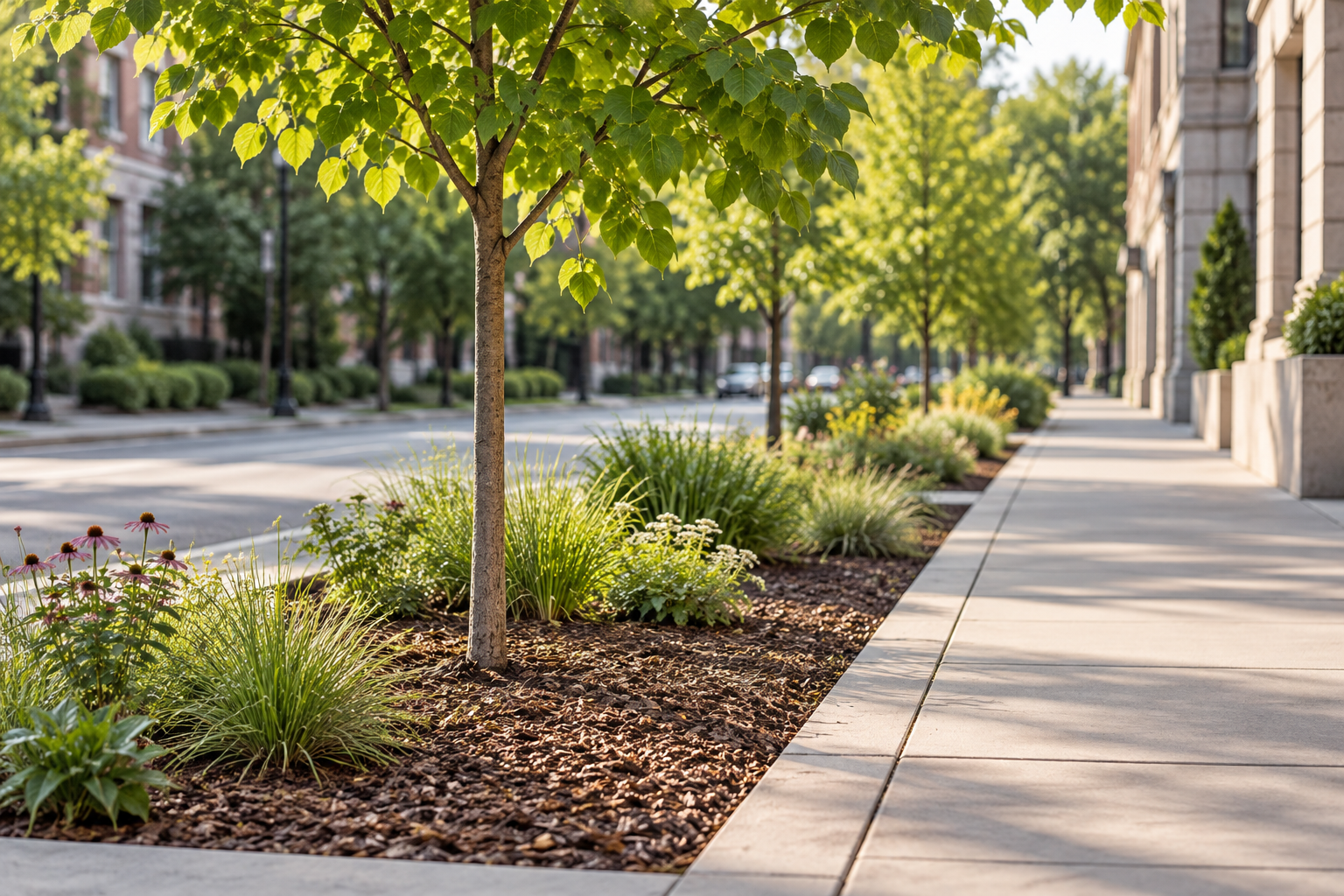
On a planting plan, a young street tree occupies a small circle. The paving, kerb and service ducts around it are drawn as if they will hold their positions. The tree is the part expected to change. Its crown may eventually reach above the street, but the drawing has already made decisions about the ground its roots can enter when the nursery root ball is no longer enough.
That future space is easy to overstate. A measured excavation is not automatically a measured rooting volume. Roots must be able to leave the planting soil, pass through neighbouring ground and keep finding water, air and a tolerable resistance to growth. A solid wall, a heavily compacted base or a saturated pocket can interrupt an apparently generous route. The design question is therefore less about the hole that fits the tree today than about the connected soil available to it in later dry summers and sidewalk repairs.
The pavement has to stand; the roots have to pass
A sidewalk needs a firm base. Conventional construction often achieves that by compacting the material beneath it. For a root, that material may become a boundary long before a designer reaches the edge of the plan. In Jason Grabosky and Nina Bassuk's 1996 experiment, English oak seedlings were planted above clay loam compacted to different densities and above compacted stone-and-soil mixtures designed to support paving. Root penetration fell sharply in the increasingly compacted clay loam and stopped at the highest test density. Roots still entered the stone-and-soil mixtures, where larger stones formed the load-bearing skeleton and soil occupied spaces between them.
That result is not a number to apply to every city soil. It came from one seedling species, one clay loam, particular mixtures and short test cylinders. Its value is in separating two jobs that are often forced onto one layer: supporting a hard surface and permitting roots to explore below it. Simply enlarging the planting opening without checking what surrounds it may leave the tree pressed against a compacted box. Conversely, a constructed route under pavement can be useful even when most of that route is invisible from above.
The route must also remain habitable. Soil pores carry both air and water. Roots consume oxygen; water filling the same pores slows the replenishment of that air. But it would be too simple to say that all pavement makes the soil beneath it airless. Kämäräinen and colleagues sampled soil air at Helsinki roadside trees during two growing seasons. Their structural soil had higher average oxygen concentrations than conventional tree soil, yet they judged aeration in the conventional soil sufficient for healthy tree growth as well. Cobblestone cover did not severely reduce ground ventilation compared with a cast-iron grate at their sites. The result asks for actual soil and cover measurements, not a verdict based on the word “paved.”
A larger tree needs a longer weather budget
Room has a time dimension. A young tree's water demand and the weather it faces will change during its life. It may draw on water in its original planting soil at first and later depend on ground beyond that soil. How much storage it needs depends on the tree's likely crown, rainfall, evaporative demand, soil texture and whether water will be supplied during dry spells.
Arthur DeGaetano's original soil-volume model used daily climate data to estimate how often a container-grown urban tree might fall below a chosen soil-moisture threshold. Its New York examples changed substantially when the assumed soil volume or irrigation interval changed. The point to carry into a street design is the method, not any one quoted cubic metre value: average weather can hide the difficult season a tree must survive. The model also made explicit assumptions about crown size, water use and soil capacity. A future planting plan should name those assumptions for its site instead of presenting a universal minimum as if all trees and climates drank alike.
Water availability and oxygen can pull in opposite directions. A shallow, dry route may be physically open but give roots little to use in a heat spell. A wet, poorly drained pocket may hold plenty of water while excluding air. The useful space is neither the largest excavation on paper nor the wettest one after rain. It is the ground through which roots can keep functioning.
Roots answer the conditions they find
Paving does more than cover soil. It can change how warm and moist the upper layer stays, altering where new roots develop. Francisco Javier de la Mota Daniel's Virginia experiment built replicated simulated tree pits in two regions and followed London plane trees for two growing seasons. Trees under a porous, permeable surface grew larger during establishment than those in uncovered pits. Their roots also developed faster and nearer the surface. The author related those differences to warmer, moister upper soil, while warning that a shallow root pattern could create future pavement conflicts or reduce access to deeper water. That is a possible long-term consequence, not a demonstrated failure of the young trees in that two-year experiment.
The response need not be the same under a different surface or climate. In a field study of 95 linden street trees in Gothenburg, Emilia Sand and colleagues compared growth with the fraction of permeable ground beneath each tree's crown. Trees with little permeable area had lower stem growth and strongly suppressed current-year shoot growth. These were established trees in one district, not randomly assigned pavement treatments; nearby conditions and management can still complicate the relationship. Taken with the Virginia experiment, the finding makes a more precise point than “paving is bad”: surface design changes the conditions roots meet, and a treatment that helps establishment can have a different effect on root placement.
The species matters, and so does the ground the roots can reach beyond the original pit. A tree is not following a fixed diagram of one deep taproot and a neat ring of laterals. It grows into the conditions that allow growth, which may place roots close to the sidewalk or carry them into a well-connected soil strip. A site survey should therefore look beyond the nursery root ball: inspect the soil at the intended edges of the root zone, where the next constraint may be waiting.
A crack is not a confession
When paving lifts near a tree, a root may indeed be exerting force. Yet a root under a cracked slab does not tell us which arrived first. In a Cincinnati study of 611 street-tree locations, Nicholas D'Amato and colleagues examined sidewalk joints beside four tree genera. Roots were more often found beneath cracked joints than intact ones. Measurements under a selected sidewalk section also found more oxygen beneath cracked areas. Some nearby joints had cracked before newly planted trees could have put roots underneath them. The authors explicitly said their observations could not conclusively settle whether a root or a crack came first.
That uncertainty is practical, not academic. A crack may give a root a path into better aerated soil, and a growing root may later widen a weakness or lift pavement. Pavement can also crack without a tree. Treating every displaced slab as proof that the species was a mistake ignores construction, age and the route the roots were offered. Treating roots as incapable of damage would ignore the other side of the interaction.
The better plan is legible below ground. It shows where the intended rooting soil begins, how it connects past the planting pit, which layers carry pavement loads, how water reaches and leaves the soil, and where future utility work might cut across it. It leaves room to inspect or adapt a site whose ground differs from the drawing. A young tree can survive for years on the space used to plant it. Its lasting growth depends on the next space—the one a root reaches when the first has been filled.
A thought worth keeping?