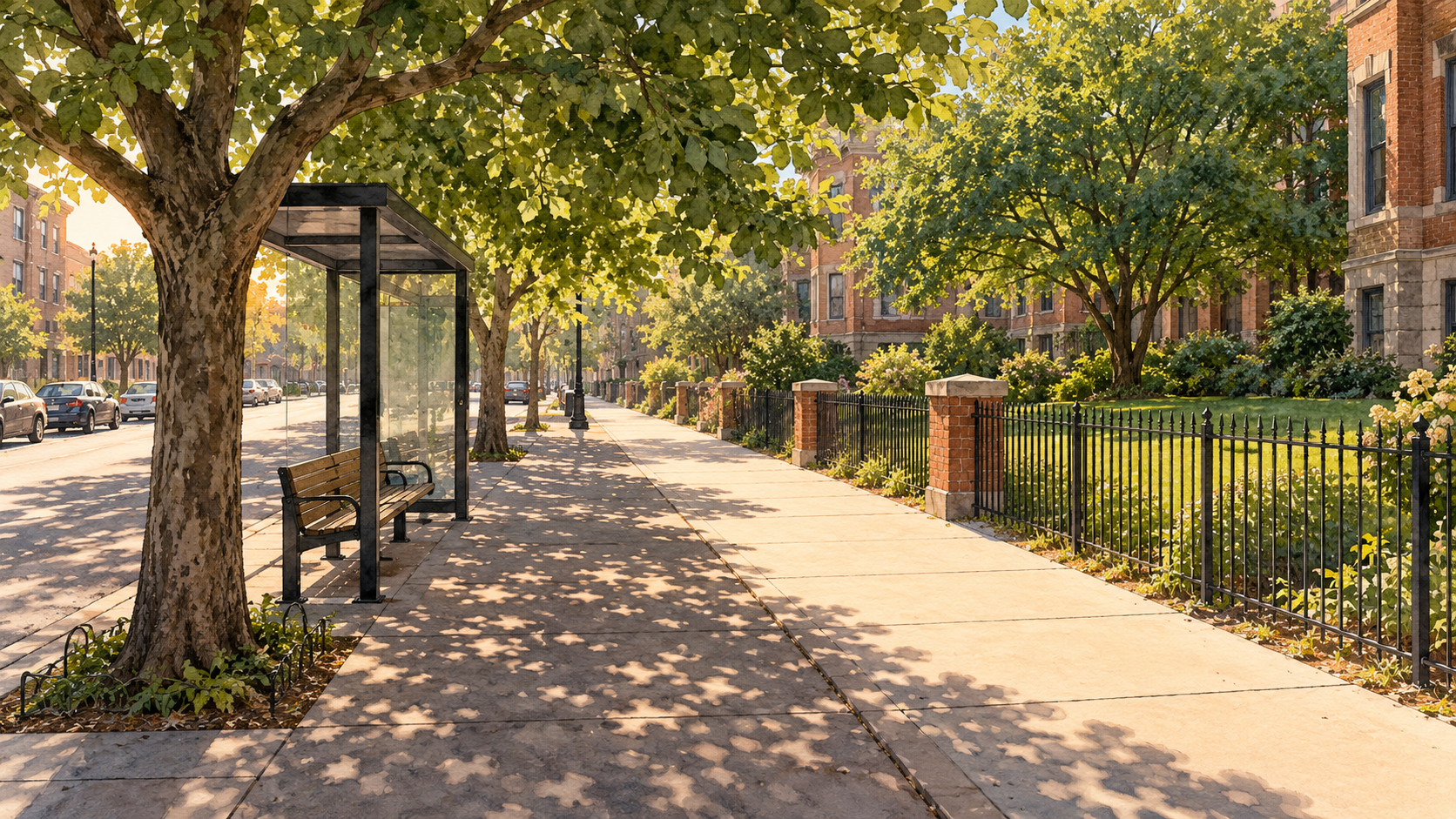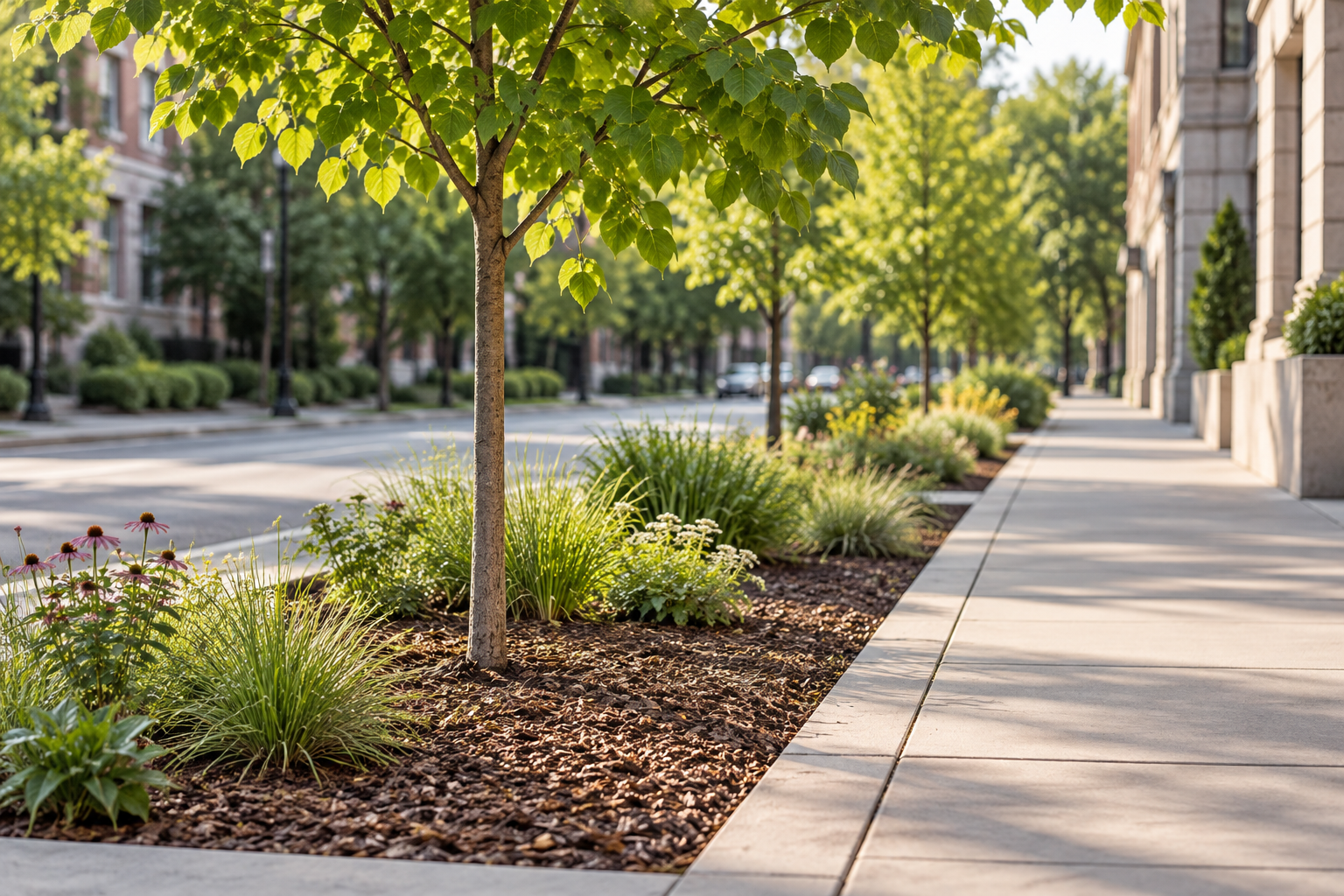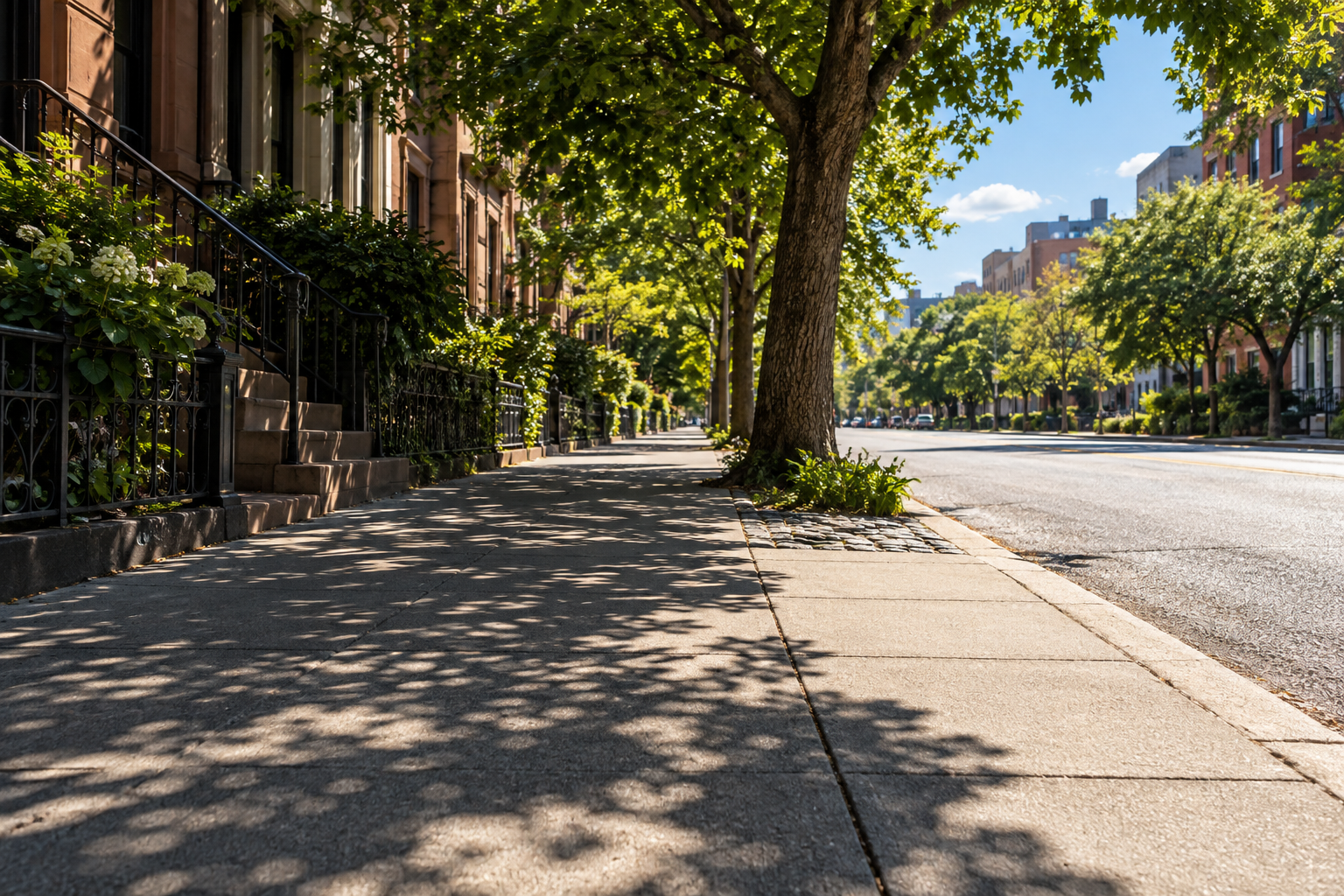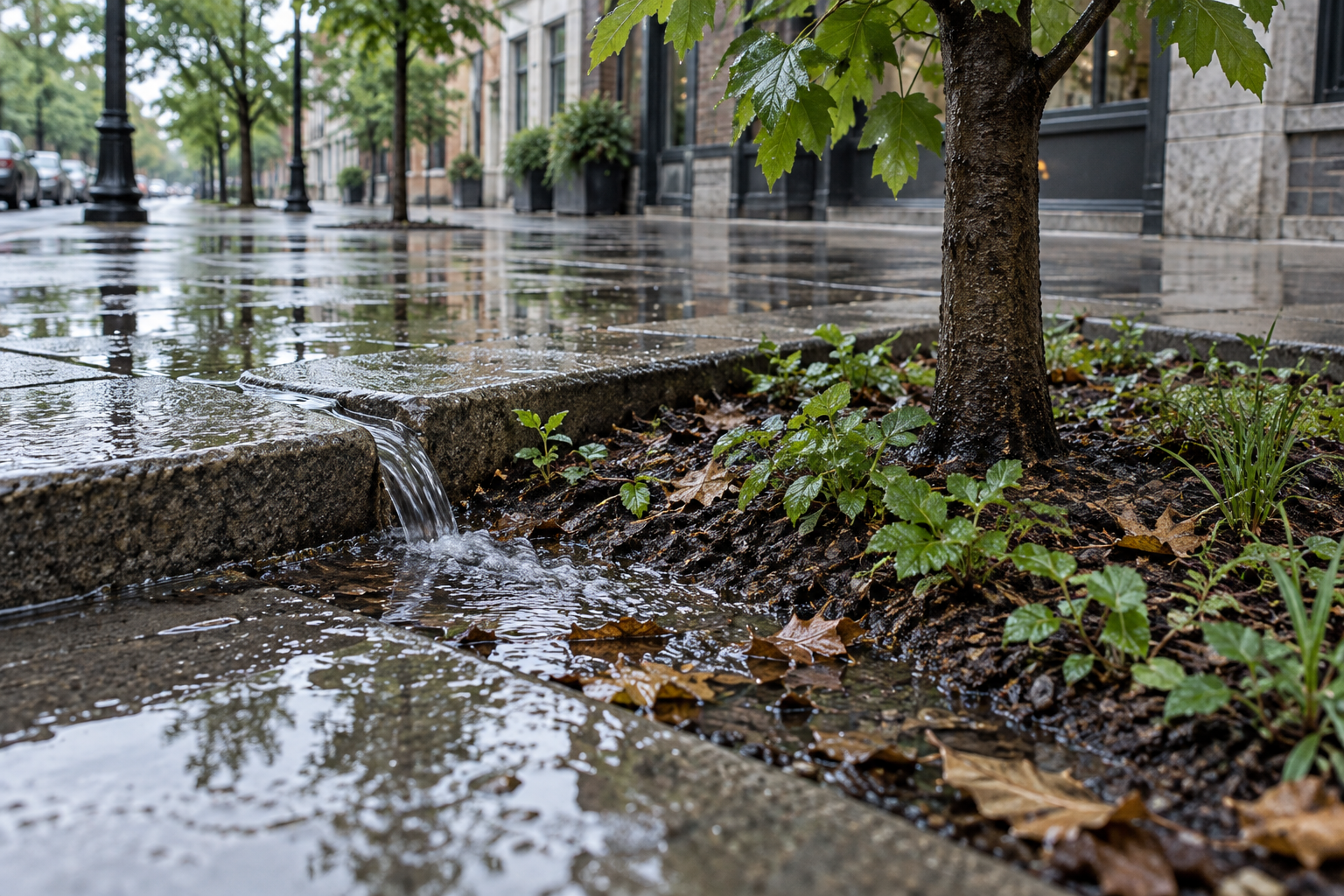
Rain can cover a sidewalk and leave the tree beside it thirsty. The tree's crown catches drops, but the water that reaches the pavement follows the pavement's slope. A raised stone rim, a packed soil surface or a drain a few metres away can decide where it goes. The small opening around a trunk is not automatically connected to the much larger wet street.
That is the practical question behind a tree pit: how does rain reach the roots, and what happens after it arrives? A useful pit needs an inlet, soil that can admit and hold water, and a route for excess water to leave. Too little of any one makes the other two less useful. A tree with a generous crown can still be planted over a dry, hard rectangle; a pit built to catch every downpour can stay wet long enough to damage the roots it was meant to help.
The canopy is only the first stop
Leaves and branches interrupt rain's fall. Some of that water evaporates before it reaches the ground; some drips through or runs down the trunk. The amount changes with the tree and the shower. In a Freiburg field study, Markus Anys and Markus Weiler measured rain beneath solitary Norway maples and small-leaved limes across 76 events during the 2021 growing season. Interception differed between the two species and varied with rainfall depth and leaf area. Their measured percentages belong to those trees, events and months. They do not tell us how much water entered a particular street tree's soil.
For the roots, the pavement outside the crown may be as important as the crown itself. A shower falling on a broad sidewalk produces runoff; whether that water can reach the pit depends on slope, curb and the height of the soil opening. In a 2023 Manhattan modelling study, Nandan Hara Shetty estimated that water entering street tree pits from adjacent surfaces could exceed rain retained by the canopy by about three to one, averaged across his modelled trees. The estimate was built from sidewalk geometry and runoff assumptions, not measured inflow at every pit. Its useful lesson is not a citywide ratio to copy; it is that the area feeding a pit may be much larger than the exposed soil around the trunk.
First, give the water a way in
An opening can be visible and still be hydrologically cut off. A raised border may keep shoes and grit away from the roots, but it can also turn runoff aside. A mound of soil near the trunk can shed water rather than let it pause and soak in. In a 2025 field study of 71 tree sites in Berlin, Laura Tams and colleagues mapped the paving, pit surfaces and connections between them. They treated barriers such as raised stone edges as a separate issue from the pit's size and measured whether connected pits had enough depression to hold runoff temporarily. Those are distinct properties: a large opening without an incoming path receives less of the sidewalk's rain, while a low opening without storage may pass a rush of water straight along.
The U.S. Environmental Protection Agency's 2016 stormwater-tree technical memorandum describes curb cuts that route runoff toward tree-growing soil and stresses attention to inlets and outlets. It also discusses more soil volume under pavement, where supported sidewalk structures can leave rooting soil less compacted. The detail is easy to miss from above: the visible square is only the top of a possible underground growing space. A tree rooted in a tiny isolated box cannot use rain stored somewhere its roots cannot reach.
Connection has to be designed for the actual street. A curb opening that works on one slope might bypass the pit on another. Water also brings sediment and road debris, so an inlet needs inspection and maintenance. Directing runoff to a tree is an engineered choice about where water will go in a storm, not simply the act of removing a kerbstone.
Then let the soil receive it
The next obstacle can be the surface itself. Rain striking soil that has been walked on, filled with fine material or compressed around construction may pond before it infiltrates. Below the surface, roots need pore spaces that hold water and admit oxygen. The EPA memorandum identifies limited soil volume, compaction, moisture and oxygen as linked street-tree problems. Making the top look loose cannot guarantee that the deeper rooting zone has room to move water and air.
The Berlin researchers tested that distinction. They measured infiltration in selected pits and tried loosening the upper soil in a subset. The change did not reliably restore infiltration; the authors suggest the restricting compaction extended below the loosened layer. Their sample was drawn from particular neighbourhoods with particular soils, so the finding is a warning to investigate depth, not a verdict that surface care never helps. It also shows why a tree pit cannot be judged by a quick glance at its mulch.
Water storage is useful only if the soil can release it at a pace the tree and site can tolerate. In an 18-month Australian streetscape experiment, Vaughn Grey and colleagues compared four stormwater tree-pit designs with conventional planting in an area dominated by clay soils. Newly planted field maples in pits that received runoff and had an underdrain grew about twice as much as conventional street trees over the study period. Some undrained pits in slowly draining ground stayed waterlogged, and their trees grew poorly or died. Yet other undrained pits drained sufficiently and supported growth. The same broad soil description did not predict every pit's fate; the local rate at which water could escape mattered.
That is the third part of the design. A pit needs to store a useful share of rain between showers, but the roots should not remain submerged for too long. An underdrain can carry surplus water away where natural drainage is too slow; in freely draining soil it may be unnecessary, and too much drainage can sacrifice water the tree could have used. The EPA memorandum treats an outlet as a way to prevent oversaturation and flooding, not as a universal recipe for every tree.
The tree will outgrow a good first season
A new tree and a mature one do not ask the same thing of a pit. In a four-year Melbourne study, Jasmine Thom and colleagues found that trees in stormwater-receiving pits with raised underdrains grew twice as fast as controls during their first two years. That faster growth did not continue at the same rate in years three and four. The authors thought the trees were likely outgrowing their small infiltration pits; some trees beside undrained pits also showed signs consistent with waterlogging. The experiment does not establish how every species or climate will behave. It does show that a successful establishment design may have a limited life if the rooting space remains small.
The Berlin survey saw a related change across tree ages. Younger trees often had larger, more open pits and designed substrates, while older trees were commonly surrounded by more paving and less favourable connections to nearby runoff. The researchers did not follow one set of trees through its whole life, so age and design history cannot be pulled apart neatly. Still, the question for an older street tree is larger than whether its original planting hole was watered: where can its roots grow and find moisture now?
Watch a tree pit during two ordinary rains and the three questions become visible. Does water from the sidewalk reach its edge? Does it disappear into the surface or stand there? After the rain stops, does the soil drain while remaining able to support the tree? A designer needs measurements of slope, soil and drainage before altering the flow; a passerby can at least notice the difference between a pit that receives rain and one that merely sits beside it. The tree needs the water to make that short journey—and enough living ground for the journey to matter.
A thought worth keeping?